Dual Pharm.D./MBA program shows student the business side of pharmacy

Kelsi Lawson, a dual Doctor of Pharmacy (Pharm.D.) and MBA student, says the program has given her a fast track to being in a leadership position at a pharmacy by giving her real-world experiences and making connections to the classroom.
After learning about the MBA program in a Pharm.D. class, she decided that it would be the best fit for her with her future career goals.
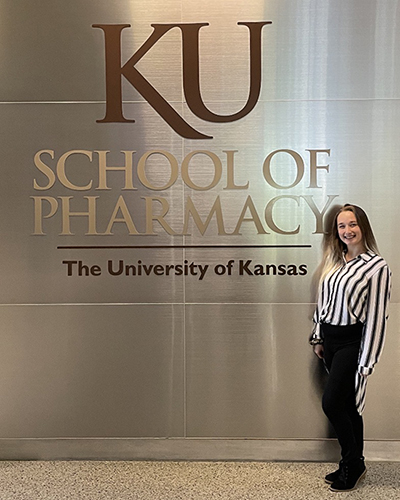
“Within a month of starting school, I knew that I could see an impact if I was interactive in my degree,” Lawson said. “If I put the work in, I was going to get the work out. You have a built-in leadership role as a pharmacist, and it just made sense for me to earn an MBA after it was offered to me.”
Originally from Wichita, Kansas, Lawson earned her associate degree from Butler Community College before relocating to KU to continue her pharmaceutical education. She knew that she wanted to be a pharmacist since she was 15 years old, citing the KU School of Pharmacy’s reputation as motivation and the knowledge she acquired during her time at the school.
“I knew I wanted to help people, and I’m really good at debating and communication,” Lawson said. “A pharmacist is like the judicial system of medicine. You are the checks and balances. You’re helping to make sure that the patient can communicate with the doctor in a comfortable way because the pharmacist is more accessible.”
Students pursuing a Pharm.D. often have two years of pre-pharmacy courses with four years of professional coursework and experience.
The KU School of Business partners with several units across the university to offer dual degree programs to help students actualize their long-term career goals. In the Pharm.D./MBA program, students join an MBA cohort during their sixth year of Pharm.D. curriculum. They also complete health-care focused projects that meet two of nine required advanced pharmacy practice experiences (APPEs). Through these projects, students engage with Kansas health care organizations to provide real-world solutions.
Upon starting the MBA program, Lawson was able to make instant connections from her business classes to her rotations (which she refers to as built-in internships to the pharmacy program). She saw supply chain management relate to the shipping-ordering process of medication, international business relate to a medical plant in Florida that was disrupted by a hurricane, and accounting relate to budgeting and adequately stocking the pharmacy.
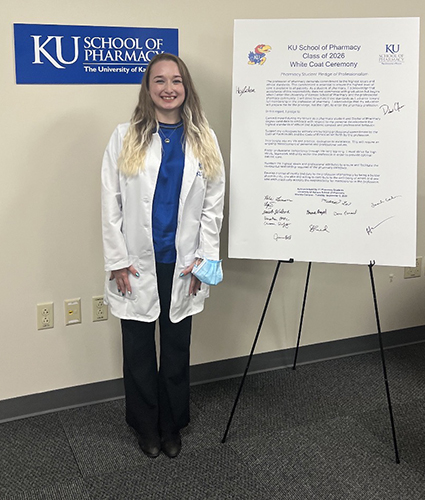
While completing a rotation at TIRR Memorial Hermann in Texas, she also was able to see how managerial roles are present in a pharmacy working under a pharmacist-in-charge, who ensures communication between nurses, doctors and pharmacists.
“I didn’t realize how much my professors would value my input,” Lawson said. “There are a lot of different majors and perspectives in the room, and professors will specifically ask how certain topics impact my field.”
Lawson says practicing pharmacists and small business owners frequently tell her they wish they had earned an MBA. She will complete the program in May 2027 and believes having these two degrees will help give her a competitive edge when applying for jobs.
"It’s been nice to get different perspectives from both schools,” Lawson said. “In pharmacy school, I’ve learned to overcome struggles in life and just keep going. But in the business school, I’ve realized that you should be kind to yourself and be forgiving. I’d tell my freshman self that it’s okay to make a misstep, and to be patient and more open, but to be kind to yourself.”
Learn more about the KU School of Business MBA and the different dual degree programs offered at business.ku.edu/dual-MBA-programs.