ENTR 410 course helps students build entrepreneurial skills, land internships

ENTR 410 Building Entrepreneurship Competency gives students practical tools for problem-solving, self-awareness, networking and for life and working through failure.
The course emphasizes customer discovery, empathy, and curiosity, encouraging students to identify their strengths and goals. One key assignment requires students to interview an entrepreneur in their field of interest.
They ask questions about the entrepreneur’s background and the business itself. The assignment has even led to some students receiving internship offers.

“Wherever an assignment can directly connect to someone’s career opportunities, that’s gold,” said Charlotte Tritch, director of entrepreneurship degree programs. “That’s exactly what we’re shooting for.”
For Drew Veach, a junior sport management major and business minor, the interview assignment led to a basketball operations internship with One Motive Sports after interviewing Drew Kelso, the company's CEO.
“It was really impressive that I got an internship from a class assignment, especially since it wasn’t even a class for my major,” Veach said. “It just reminded me of the importance of the fact that every class can be a new opportunity for yourself. Being in the sports world, it’s hard to get somebody to talk to on the phone. If I never had that project, I never would have had the ability to network or connect with Kelso.”
Malea Schulte, a senior business administration major, gained an incredible network of resources from the class while enrolled in fall 2024. Schulte interviewed LaToya Sirls of Someday Sunday, a vegan beauty brand based in Kansas City, after a recommendation from Beth Embry, assistant professor of entrepreneurship.
During the interview assignment, Schulte expressed her interest in interning for Sirls after realizing how closely the company aligned with her interests, and accepted a position as a sales associate, later being promoted to a sales and marketing associate. During her internship, she worked closely with Sirls for product launches, product scent tests, label design, data analysis and manufacturing.
In the course, students also keep analog journals and work on a semester-long final project. The project begins by identifying a problem in their everyday lives and constructing a solution via customer discovery and building a business model. Assignments like the entrepreneur interview and the semester-long project help students apply entrepreneurial thinking to real—world scenarios, working alongside students representing a variety of majors.
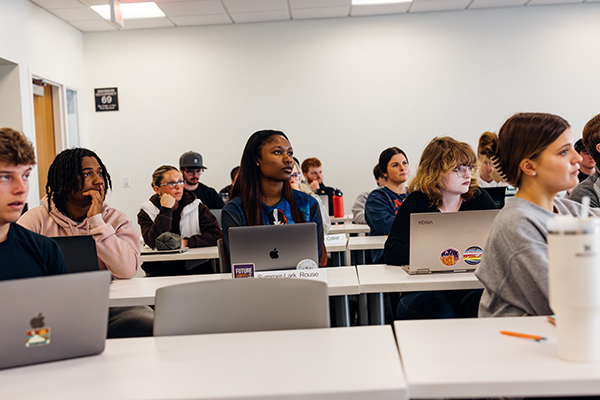
“For us, entrepreneurship isn’t about business,” Embry said. “It’s about a way of thinking and a way of approaching problems with openness and curiosity. Every core component of the course that students will interact with is in the context of an existing business. We do this through case studies and look at how things have played out for other businesses. Moving through the semester, you’re applying that knowledge in a semester-long project to get to the final.”
These student experiences reflect the course’s broader mission: to equip learners with entrepreneurial competencies that transcend disciplines. Through hands-on assignments, collaboration across majors, and real-world applications, ENTR 410 fosters a learning environment where students build confidence, expand their networks, and develop practical skills. Tritch and Embry say this interdisciplinary approach is key to preparing students for the diverse challenges they’ll face in any career path.
“In reality, organizations — startups, new ventures, companies, nonprofits, any kind of organization — are made up of people who have different and complementary skills and abilities,” Tritch said. “Being able to figure out a way to have our programs and courses allow different people to come together and work together is huge…to be able to have that exposure to other majors…and get different points of view and look at ways to solve problems that you wouldn’t have thought of if you would not have been sitting next to somebody [understanding scenarios] from a totally different lens is [what’s really exciting].”