Human-AI interactions stimulate coordination among co-workers and improve team performance, study finds
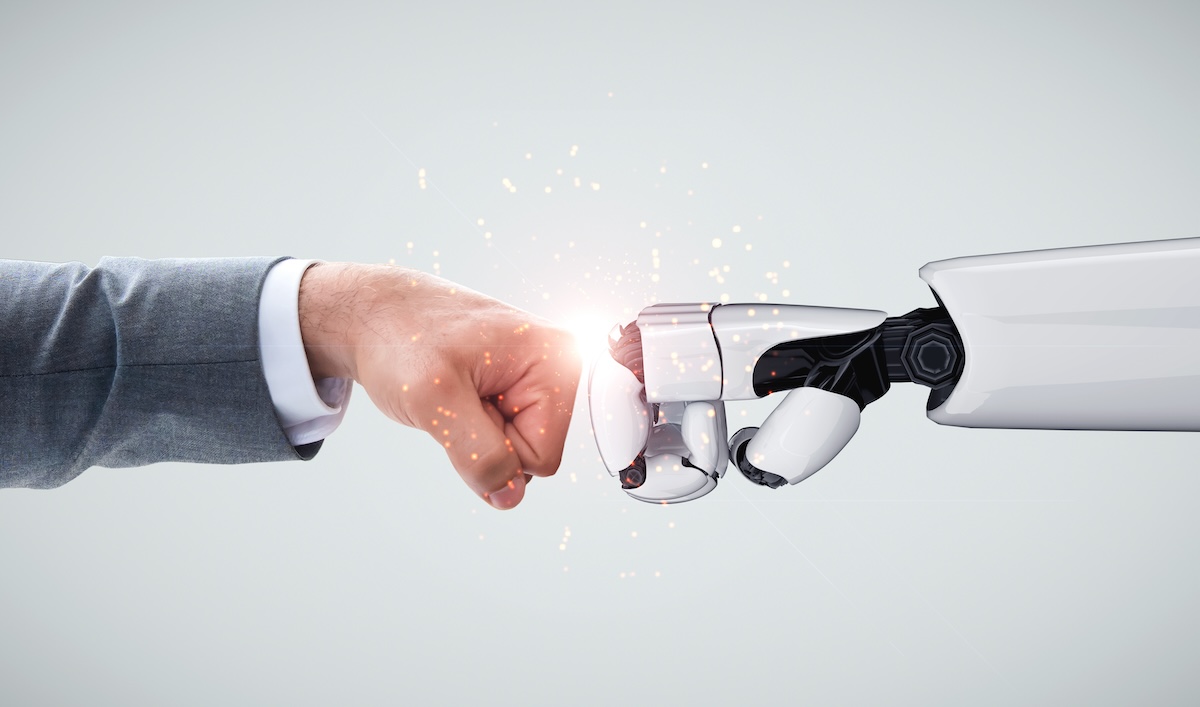
LAWRENCE — Artificial intelligence is rapidly inserting itself into various forms of human engagement. Consequently, many fear AI may be creating barriers that obstruct or prevent relationships between people.
A new study by Todd Hall, assistant professor of business at the University of Kansas, reveals AI may actually motivate individuals to interact more with one another.
His article titled “Does Artificial Intelligence Stimulate or Diminish Human Interactions? An Affordance Perspective on AI, Relational Coordination, and Performance” finds that AI can do more than just augment or substitute for human capabilities. Instead, human-AI interactions can stimulate relational coordination among individuals and improve team performance.

The article appears in Production and Operations Management.
“We wondered if when an AI tool is introduced into a team setting, do people just ignore their teammates and focus on the tool?” asked Hall, who co-wrote the article with John Gardner and Zachary Wright of Brigham Young University.
“We find the opposite happens. People use the tool as a stimulant to their interactions with other people. They use it as a topic of discussion. They build relationships over discussing what the AI is recommending. People do choose to interact with other people.”
Hall said his is one of the few papers in any field focusing on how AI affects human-to-human interaction.
“A lot of the research out there is about how humans interact with AI. How does it change their decision-making? Ours asks, ‘AI is already there, so how is this affecting your relationship with other humans who are also there?’” he said.
The study was conducted using a synchronous behavioral lab experiment — what Hall terms a “classic interdependent decision-making team” — in which participants managed a simulated factory in teams of three. Each participant played the role of operations, quality or demand manager, making decisions over 10 rounds to adjust operations to meet fluctuations in simulated plant performance and external demand.
“The most surprising thing was how frequently people chose to use AI to engage with their colleagues, meaning there is a lot of heterogeneity in how they interact with AI,” Hall said. “Some people did just read it, follow it, type it in. But the most common thing was people used the AI as a conversation starter and a relationship builder.”
The professor observed several concrete ways in which AI can stimulate human interactions.
“One is it helps people trust each other more. And this is particularly in cases like this study where the teams are new. In one of them, they have experience working together, and other ones, they’re just thrown together. ‘Do I trust what this person’s talking about?’ But if they’re telling me something that I know is backed up by AI, you’re essentially getting two opinions in one,” he said.
It also assists individuals in getting past uncertainty.
He said, “If you’re starting something new and don’t really know what you’re doing, a lot of your time is dedicated to just figuring things out. If you have AI to help get you past some of the hurdles of figuring out details, it can allow you to shift your focus to building relationships.”
Now in his fourth year at KU, Hall studies how people organize around technologies. Before going into academia, he helped hospitals implement billing software as a project manager for Epic Systems.
Despite his research interest, Hall said he understands the dangers in over-reliance on such emerging technology.
“It’s easy to get to a very scary place when you realize, ‘OK, think of the last three years. OK, think of the next three years. If we improve at the same rate, things are going to become bad for all of us,’” he said.
“Yes, there will be options in business and other parts of our day-to-day lives that will be taken over by AI. Ultimately, people will need to make a choice that they prefer human interaction … and I think people are going to choose humans.”