KU Business faculty experts discuss: Last-mile delivery, transportation and parking
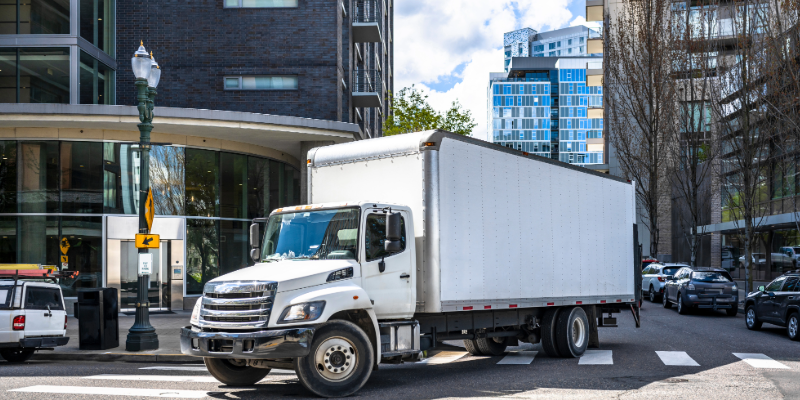
Recent increases in consumer preference for convenience and online shopping has caused the e-commerce market to grow tremendously in recent years, with the market size expected to reach $1,526.42 billion by 2030, according to a Grandview Research report.
One result of this growth is an increase in parking challenges and delivery-driver traffic, specifically in urban areas during busy periods like the holiday season.
As we enter this popular shopping season and delivery drivers take on busier roads, experts are exploring the future of overcoming this challenge. Sara Reed, assistant professor of business analytics, has been exploring this impact through research into last-mile delivery, parking and routing decisions for drivers and businesses.

Reed is an expert in transportation logistics, and her recent research explores potential new technologies and solutions for challenges associated with parking and delivery. She received both her doctorate in applied mathematical and computational sciences and her master’s in mathematics from the University of Iowa, before joining the KU School of Business in 2021. At KU, she teaches undergraduate students in the business analytics program through courses in data analysis and forecasting and data mining and predictive analytics.
What sparked your interest in researching last-mile delivery, transportation and parking?
As I was pursuing my doctorate in applied math and computational science, I worked with multiple people who were experts in transportation logistics, which led me to study that concept.
The first question we asked while exploring this was “What is the value of autonomous vehicles?” This led us to find that you could drop off a delivery person at one place and pick them up at another, which can be extremely beneficial if you don’t spend time finding parking. This revealed that parking is a huge challenge, but no one is really exploring it, so that’s where I’ve centered my research agenda: thinking about different aspects of parking challenges and last-mile delivery.
Why has parking and last-mile delivery become a more relevant topic in recent years?
With technology improving, there’s the potential for smart city infrastructure to assist with understanding parking. That could mean being able to say whether parking spots are available before drivers arrive, or other similar initiatives that can benefit users. It’s important to learn how we can translate these ideas into urban environments and use the information.
Overall, we can also consider that there is an increase in the number of packages, but there is also a significant rise in the ways we — as consumers and businesses — use curbside. Certain delivery people use curbside, but with rideshare services like Uber and Lyft, they need the space as well. This also includes food delivery services like DoorDash, which has caused an overall change in the number of people and entities using curbs, making parking increasingly significant in its impact on operations overall.
Are these concerns heightened during the holidays or busy shopping seasons?
Along with the inevitable increase in packages ordered and shopping done during the holiday season, businesses also make changes at this time. From an industry perspective, a lot of companies will hire seasonal workers, which is similar to what my research considers.
In addition to using autonomous vehicles during busy seasons, companies can also bring in extra drivers using traditional vehicles to provide additional support. This two-person model allows both drivers to work simultaneously, and one can even be dropped off to continue deliveries while the other proceeds to a new location. This approach increases overall efficiency, which my research further explains.
And this doesn’t require any new technology. While the cost is primarily the extra salary, it’s also important for companies to understand how this practice may positively impact their overall operations during busy seasons.
What role can consumers play in easing last-mile congestion (e.g., pickup lockers, consolidated deliveries)?
Because of easily accessible e-commerce and quick delivery, consumers have gotten used to instant gratification.
They can now get what they want, where they want it and how they want it, quicker than ever before. Furthermore, extensive delivery networks have made us rigid with our preferences and expectations, so we may not understand the implications of traffic congestion or sustainability.
To ease this, we as consumers can allow additional flexibility through tactics such as customizing all packages to be delivered on the same day or taking other similar initiatives that help with optimizing routes and ensuring balanced deliveries in certain areas.
How can businesses better address these issues during busy seasons?
There are various business models that companies could consider. Whether it’s a model where you have a helper on board a vehicle, or alternative models like locker boxes that consumers can opt into, we may be able to help minimize congestion.
This is a two-sided effort, though. Consumers must be willing to compromise and potentially pick up packages in certain areas to benefit overall congestion, and companies must implement incentive structures for them to want to do so.
What can cities do to ease the pressure on delivery drivers?
Cities can ease pressure on drivers, who face competition for curbside space from ride-hailing and food delivery services, by adopting dynamic management of loading zones and optimizing regulatory policies.
This involves continuous monitoring of vehicle presences in loading zones to understand time-sensitive demand and the primary use case (e.g.: commercial vs. residential) at specific moments.
Furthermore, cities must be aware of the implications of various policies, such as adjusting the maximum allowed dwell time and implementing advanced reservation protocols, even for short durations.
What solutions have you seen implemented recently? What long-term solutions or technologies do you expect to come about in the future?
Right now, I’m looking at the value of real-time parking information, which helps drivers understand which parking spots are available and which are not, something that is also reliant on the ability of smart city infrastructure to do so.
There are tradeoffs to this model, such as deciding how many customers you could serve from a singular parking spot and monitoring how parking changes in a short period of time, which also have implications for route planning.
What are the potential benefits and drawbacks of businesses implementing technologies, such as self-driving deliveries, to solve these issues?
These solutions allow flexibility that we don’t currently have in a traditional vehicle, which inherently improves operations.
On the other hand, there can be restrictions and legal parameters that need to be determined for many of the potential solutions, such as self-driving cars. Until these guidelines are firmly understood, we can’t really think about how we will operationalize them, in fear of making assumptions, which makes it hard to understand real-world implications.
Where do you see your research going in the future?
I have one paper, titled “Does Parking Matter? The Impact of Parking Time on Last-Mile Delivery Optimization,” which established that yes, parking absolutely does matter, and led to my direction of diving into the “when” and “how” in my next research.
I want to understand how we can answer these questions to then adapt to the answers and react to parking problems in real time.
While current research focuses on the planning level, I’m now looking at the operational, moment-to-moment level of parking for drivers. My goal is to model a smart decision support system for drivers to optimize routes and delivery strategies.