KU Business hosts first Keeler Professor for interdisciplinary research rethinking workplace wellbeing
This fall, the KU School of Business welcomed Meredith Bagwell-Gray, associate professor of social welfare and 2025–26 recipient of the KU Keeler Family Intra-University Professorship, for an interdisciplinary research collaboration.
She has been working alongside Elizabeth Embry, assistant professor of entrepreneurship, to create an original research project bridging perspectives from social welfare and business. This marks one of the first times that the School of Business has hosted a Keeler professor.
Named in honor of W.W. Keeler, former president of KU Alumni, and awarded to tenured faculty in their pursuit of collaboration across disciplines, the Keeler Family Intra-University Professorship creates an opportunity for faculty to expand their research and instructional capacities.
Embry and Bagwell-Gray's research collaboration focuses on trauma-informed workplaces. Their research partnership kicked off at the same time as Embry's New Faculty Research Development Award through KU’s Office of Research, allowing for more opportunities with their collaboration paired with the Keeler professorship.
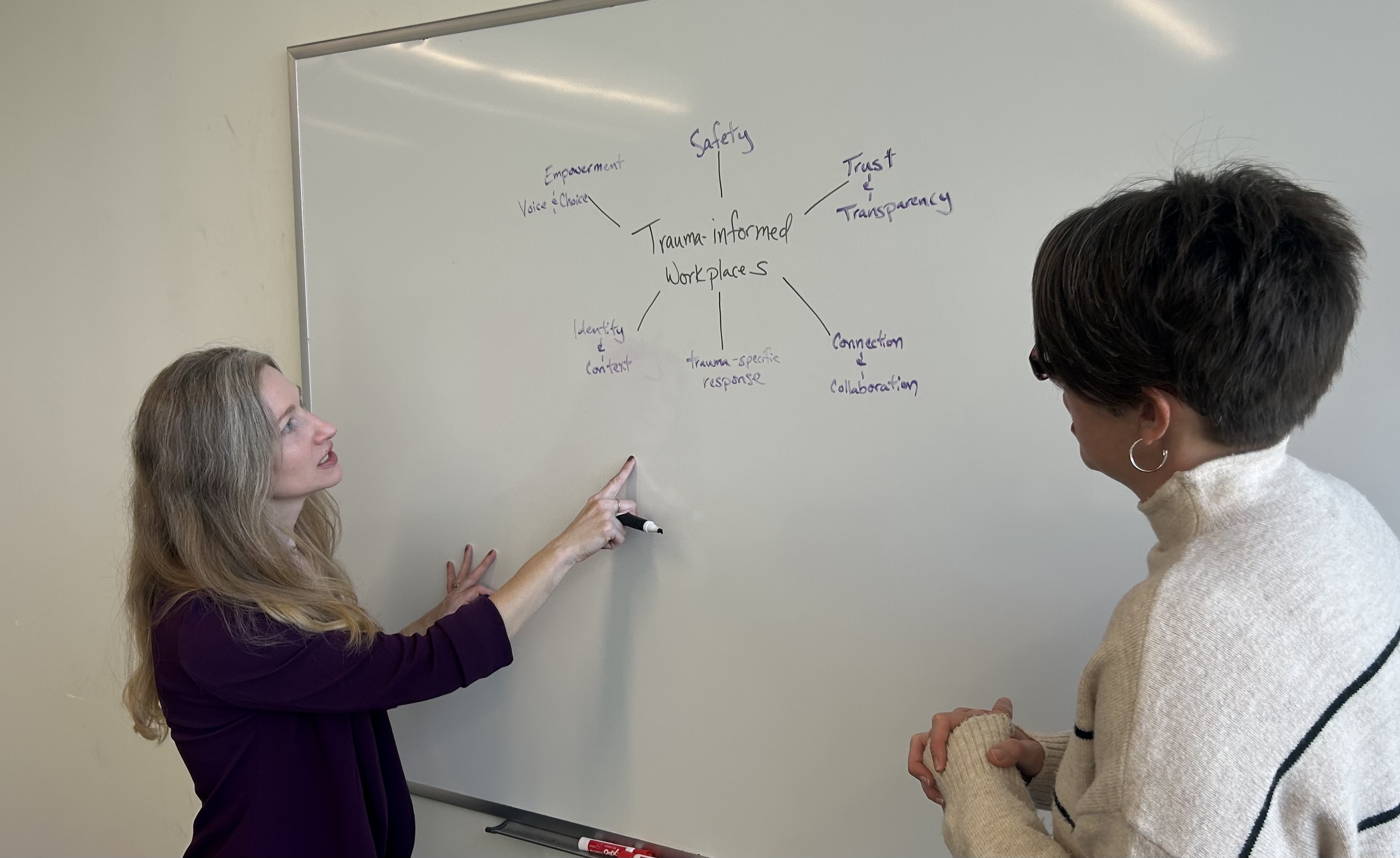
This unique research combines Embry’s background and interest in public health, working environments and entrepreneurial opportunities with Bagwell-Gray's studies, such as her research on intimate partner violence and its effects on women’s health and safety.
“I was drawn to KU because of its commitment to creative, innovative and impactful research and the infrastructure that supports it, such as the Keeler Professorship,” Bagwell-Gray said. “The longer I’ve been here, the more I’ve been exposed to other units and how they do things.”
Although they primarily worked together on research, Embry and Bagwell-Gray's friendship started outside of work, when they met at their daughters’ soccer practice.
After making their KU faculty connection, they realized that they both had published research on understanding trauma through different lenses. When Embry asked Bagwell-Gray for a friendly review of her paper, “If the Body Keeps the Score, What Happens When You Bring the Body to Work?,” Bagwell-Gray provided a new perspective on the topic using the Trauma Informed Care (TIC) lens, inspiring both women to combine their disciplines on a new level.
“I think the exciting thing for me was to hear that someone from business was thinking about trauma, because in social services, we talk about trauma a lot,” Bagwell-Gray said. “It was interesting to learn about how Beth frames thinking about trauma to see how it connects to how I think about it.”
Together, the professors launched an original research project: a cross-case comparison study of trauma-informed workplace practices to support employee mental health and well-being across a variety of workplaces. The Keeler Professorship supports these research endeavors while allowing Bagwell-Gray to use the findings to develop a textbook.
“What makes this partnership both fun, but also challenging sometimes, is the interdisciplinary aspect of our research,” Embry said. “The points of view that we each bring to the table are really interesting. We’re having to talk about how we translate these points into literature for our respective areas of focus.”
TIC, a widely adopted approach in health care and social service industries, recognizes the ongoing impact of trauma and emphasizes the importance of creating safe and supportive environments for those who have experienced it.

While developing their collaborative article, they investigated how reframing TIC through a lens of everyday workplaces could help equip businesses with practical strategies for embedding employee care into their daily operations.
Embry is able to contribute a unique perspective to this topic through her research on the body’s reaction to trauma, and how it may manifest at work.
“While no two individuals experience trauma in the same way, it does show up in the same way in the body,” Embry said. “If you’re affected by trauma and constantly searching your surroundings for safety, you cannot access the frontal cortex of your brain, which is what you need for creativity, critical thought and connection at work.”
TIC is currently focused on the supplier to client relationship in social work and medical fields, but Bagwell-Gray and Embry want to emphasize that “trauma is not a jacket you can take off when you come to work,” and use theory to identify the principles and suggestions they can give to the world of business as they adopt this idea.
Reflecting on their unique approach to trauma-informed workplace culture, Bagwell-Gray and Embry explain that doors have just kept opening for this collaboration because of their focus on survivor experiences and the integration of business framework to support meaningful change.
The women have begun posing case studies on companies that are already attempting to create trauma-informed workplaces, allowing them to analyze their operations and compare them across industries.
One organization that stood out to them was Porter House Kansas City (PHKC), where the women have seen a strong example of a trauma-informed workplace with a focus on the built environment. Their retail space offers various seating options that can be rearranged, which aligns with the TIC principle of empowerment, and cozy touches such as throw blankets that communicate a welcoming atmosphere.
The research will be synthesized to appeal to both social work literature and business to create a study that both audiences can find useful.
Bagwell-Gray and Embry hope to not only help trauma patients reclaim their identity through work but also provide businesses and their leaders with realistic ways to adopt principles of the Trauma Informed Care Model.
“It’s been really fun to learn about how many business scholars think about these things, and I’m excited to bring that back to social work and social welfare to share how we can both learn from the School of Business and bring knowledge to them as well,” Bagwell-Gray said.