Business administration major translates language studies into international career
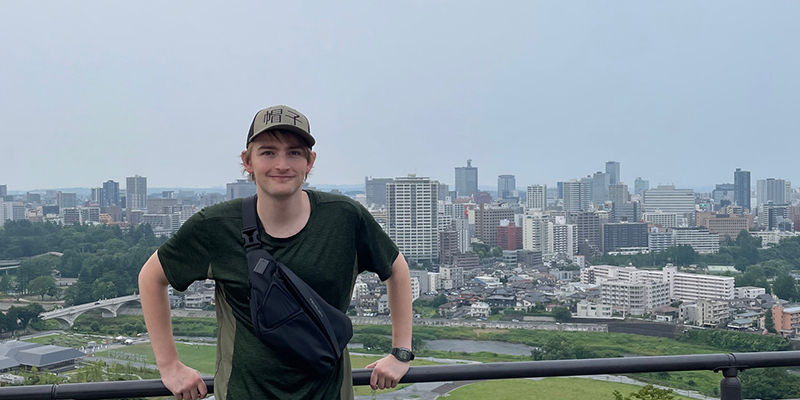
Nathan Spickelmier, a senior business administration major, began his academic journey during the early days of the COVID-19 pandemic. He graduated from high school in 2020 without a definite plan for future schooling. In the peak of boredom, a YouTube video of a man speaking Japanese caught his attention. What started as a simple hobby quickly became the center of his career.

The Kansas native enrolled at Johnson County Community College (JCCC) to pursue his Japanese interests in a more formal setting. He finished out his associate degree through his first study abroad experience at J. F. Oberlin University in Japan.
“I learned this language for two years, so at this point it would be a shame if I didn't go and actually use it,” Spickelmier said. “I felt like there was no proper place to test myself on how much I progressed without going abroad.”
Japan changed his perspective. Spickelmier had never traveled outside North America and initially felt culture shock with the new way of living and communicating. Despite the challenges, he embraced the learning experience during his five months abroad.
The university supported his academic goals and arranged for him to have a language partner in class to become more conversational in Japanese. Outside the classroom, he explored daily life, navigated public transportation and connected with people from all over the world.
Finding value in business
After returning home in 2023, Spickelmier felt he needed a stronger academic background to pursue future career endeavors. KU was his natural progression from JCCC. The campus offered close proximity to home and a range of academic programs. He entered the School of Business and chose business administration as a foundation for his career.
“I first started my academic journey, and really all that I cared about was learning Japanese, and then, through KU, I realized that I liked business, and it felt very applicable to almost every aspect of life,” Spickelmier said. “That made me more confident in my decision as it gave me a lot more avenues to approach employment after I graduated.”
He still had an itch to go back abroad after completing one semester on campus. Ian Adkins, international programs coordinator in the KU School of Business, helped fuel that momentum. He introduced Spickelmier to scholarship opportunities and guided him through each step and logistical challenge to make the experience possible.
“Ian is one of the best people I have spoken to in terms of supporting students and showing how much he cares,” Spickelmier said. “It is less about what he needs and more about how we can make this experience geared to your needs to make this possible.”
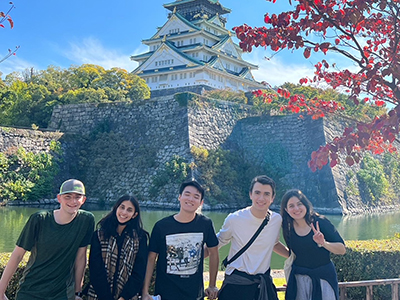
He confidently boarded an international flight to spend his spring semester studying at the University of Sophia in Tokyo, Japan. Returning as a second-time international student, the city felt familiar. Spickelmier now had the freedom to shape the experience on his own terms.
He built friendships from around the world, both personally and professionally. He completed his courses and gained a deeper understanding of the culture and life abroad. As his experience developed, he looked for a way to use both his Japanese skills and business background.
Returning with intention
The CIEE program opened the next door for Spickelmier. Following his time as a student abroad, he secured an international business consulting internship at Intralink in Tokyo, Japan.
Intralink is a business development consulting firm that fosters international company expansion by connecting them with overseas customers, partners and market opportunities.
As an intern, he helped foreign startups enter the competitive Japanese market. He attended trade shows, identified potential partners and supported clients to bridge any cultural gaps. Spickelmier saw firsthand how culture shapes business. In the United States, a person may take a more direct approach to create a partnership with someone and directly lay out their wants and needs. However, in Japan, these professional relationships are eased into with multiple meetings, creating a more gradual process. Spickelmier took note of these key differences and adapted his business manners to align with the cultural standards.
“It doesn't matter where you are; people are people. They might have different customs or different ways of doing things, but we are all human, and people will appreciate you if you appreciate the things they do,” Spickelmier said.
Translating the experience at home
At KU, he spends his time guiding other students as a study abroad student advisor for the School of Business. Spickelmier uses his own experience to help students navigate the application process and find a program that is best fit for one's academic and personal objectives.
“I am helping others who want to go on the same journey that I did, and that is super fulfilling because it changed my life. There are so many great experiences out there that I want to be able to help people lower the barriers to enter as much as possible,” Spickelmier said.
While completing his final semester, Spickelmier started a full-time role as a translator for Panasonic Energy's facility in De Soto, Kansas. His job is to support communications between Kansas and Japan to ensure alignment across projects and prevent costly misunderstandings. He plays a vital role in maintaining a global workforce.
At Panasonic, Spickelmier works alongside translators who have spent more than a decade with the company. He gets the chance to see firsthand how they navigate their work and perfect it over the years. This mentorship has instilled a core principle for him on how to approach growth.

“A great word in Japanese that we use at Panasonic is ‘kaizen,’ which means continuous improvement through small changes,” Spickelmier said. “Small improvements over time build on top of each other, and you eventually become much more efficient and better at the thing you are doing.”
Spickelmier’s goal is to continue to work in the field of international business to help bridge the gap between the U.S. and Japan. Whether that is done by staying close or going back abroad, he is building a future centered on global connection.
“There is no reason not to at least go talk with someone about studying abroad,” Spickelmier said. “You never know how it might impact your future, and I have never heard someone say they regretted it.”